Volume eating for weight loss is one of the most practical strategies I teach my clients – especially the ones who come to me saying they hate feeling hungry. If you have ever tried to cut calories and ended up miserable by 3pm, you are in the right place. In this post, I am going to walk you through exactly what volume eating is, which foods make it work, and how to build meals that actually fill you up.
What Is Volume Eating and Why Does It Work for Weight Loss?
The Basic Idea
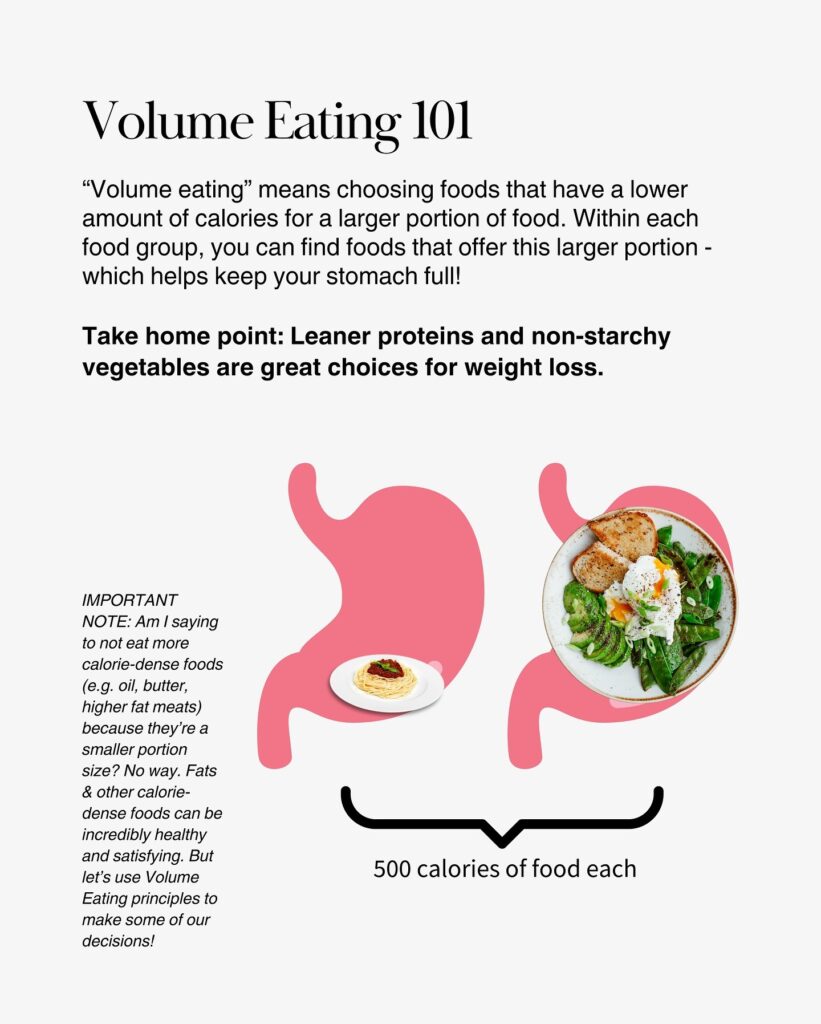
Volume eating means choosing foods that give you a larger portion for fewer calories. Instead of eating less food, you eat smarter food. Your stomach physically fills up, hunger signals decrease, and you stay satisfied longer – without blowing your calorie budget.
This is not a trick. It is basic biology. Your stomach responds to the volume of food you eat, not just the calorie count. It is one of the first things I explain to my clients because it genuinely changes how they think about their plate.
The Key Principle
In my practice, I always come back to this: leaner proteins and non-starchy vegetables are your best tools. They take up the most space in your stomach for the fewest calories. When you build your meals around these two categories, you can eat a genuinely big plate of food at every single meal.
Volume Eating 101: Understanding Calorie Density
What Calorie Density Actually Means
Not all 500-calorie meals are created equal – and this is something I show my clients all the time. Five hundred calories of pasta is a small bowl. Five hundred calories of lean protein, vegetables, and a little fat is a full, satisfying plate. Same calories. Completely different fullness.
That is the power of choosing lower calorie-density foods for the bulk of your meal.
An Important Note on Fats
I want to be clear about something. Volume eating does not mean avoiding fats or calorie-dense foods entirely. Healthy fats are satisfying and nutritious, and I am not here to tell you to cut them out. The goal is to use volume eating principles to guide most of your choices – not to eliminate whole food groups.
The Best Foods for Volume Eating
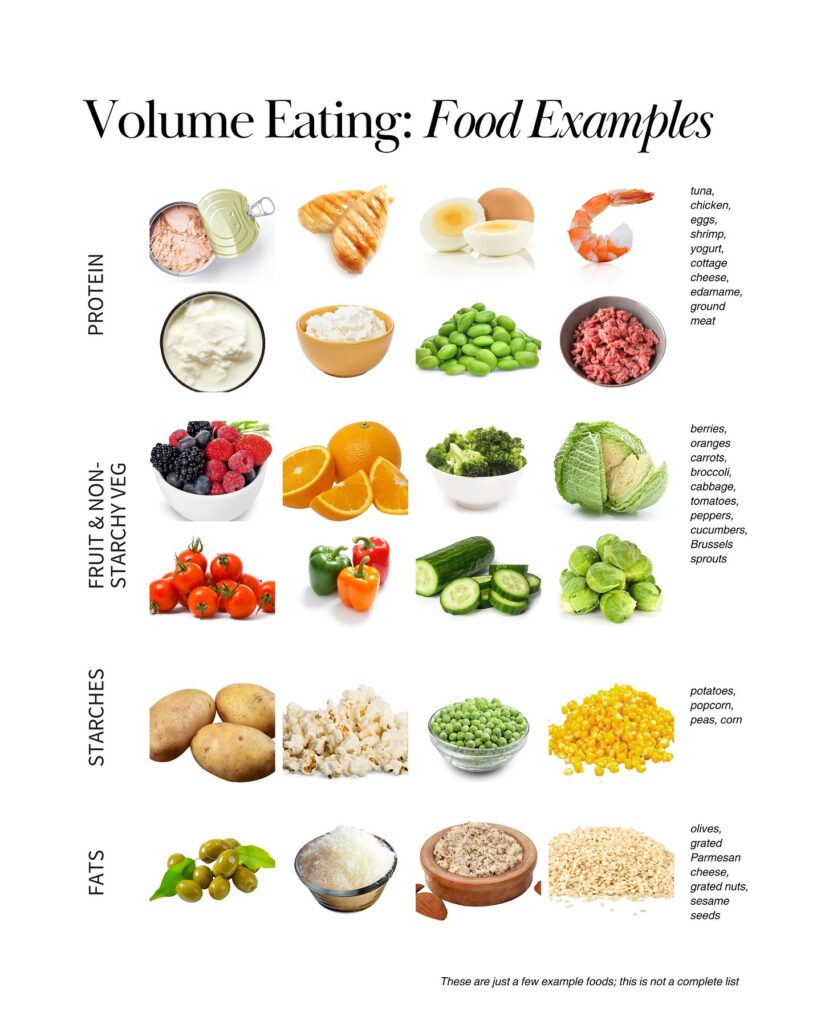
Protein Picks
Lean proteins give you the most fullness per calorie. These are the ones I recommend most often:
- Canned tuna or salmon
- Chicken breast
- Shrimp
- Eggs
- Greek yogurt or cottage cheese (3/4 to 1 cup)
- Edamame (3/4 cup shelled)
- Ground turkey or extra-lean ground beef
I tell my clients to aim for at least 4 oz of protein per meal – roughly 150 calories or more. This is the anchor of a volume eating meal and the piece most people are missing.
Fruit and Non-Starchy Vegetables
These are your volume superstars and I want you to pile them on. My go-to picks:
- Berries, oranges, apples
- Broccoli, Brussels sprouts, cabbage
- Cucumbers, zucchini, celery
- Spinach, salad greens, peppers, tomatoes, mushrooms, onions
We aim for at least 2 cups of veggies per meal with our clients. This is where you get serious volume with minimal calories, and it makes a real difference in how full you feel.
Starches (Optional, About 100 Calories)
If you want a starch, here are the options I suggest:
- Potatoes or winter squash (1 cup chunks)
- Popcorn
- Peas or corn
- Cooked wild rice, pasta, oats, quinoa, or barley (1/2 cup cooked)
- Beans or lentils (1/2 cup)
This is optional at each meal – not required. I always tell my clients to add it when they want it and skip it when they do not.
Fats (Keep It to 1-2 oz)
Fats are satisfying but calorie-dense, so a little goes a long way. Here is what I recommend:
- 1 to 2 tablespoons of oil or butter
- 8 to 16 olives
- 1/2 to 1 avocado
- 1/8 to 1/4 cup nuts or seeds
- 1 to 2 oz cheese
- Grated Parmesan or sesame seeds for adding flavor without losing much volume
How to Build a Volume Eating Meal
The Meal Formula
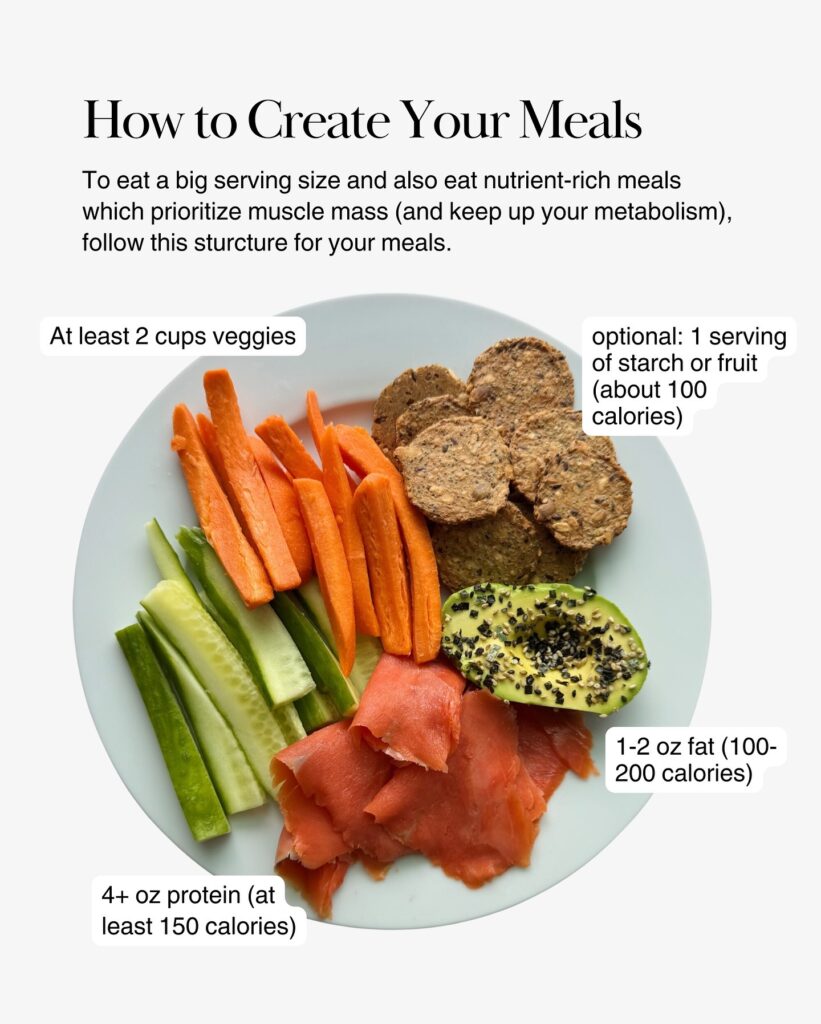
This is the structure I give every single client when they start working with us. You do not need to overthink it:
- At least 2 cups of non-starchy vegetables
- 4+ oz of lean protein (at least 150 calories)
- 1 to 2 oz of fat (100 to 200 calories)
- Optional: 1 serving of starch or fruit (about 100 calories)
Mix and match within each category based on what you have and what sounds good. That is it.
Real Meal Examples Using the Formula
Not sure where to start? Here are a few combinations I love and share with my clients regularly:
- Canned tuna + cucumber slices + cherry tomatoes + a handful of olives
- Ground turkey + zucchini + spinach + 1 tablespoon olive oil + 1/2 cup cooked rice
- 2 eggs + cottage cheese + peppers + a piece of fruit on the side
- Shrimp + broccoli + mushrooms + avocado + a side of beans
Each of these follows the formula. Each one is a full, filling meal.
Can You Really Lose Weight Eating Big Meals?
Yes – and this is exactly what I want you to understand. Weight loss does not require tiny portions. It requires smart portions. When you fill your plate with lean protein and non-starchy vegetables first, you naturally crowd out higher-calorie, lower-volume options. You eat less overall without feeling deprived.
Hunger is one of the biggest reasons my clients struggle before they find me. They are white-knuckling through low-calorie days and wondering why they cannot stay consistent. Volume eating fixes that. You are eating real, satisfying meals and still creating a calorie deficit. That is a plan you can actually stick to – and that is exactly what we focus on in my Best Body program.
Frequently Asked Questions About Volume Eating
What foods are best for volume eating?
Lean proteins and non-starchy vegetables are your best choices. Foods like chicken, canned tuna, shrimp, eggs, cottage cheese, broccoli, cucumbers, spinach, and peppers give you a large portion for very few calories. These are the foods I build my clients’ meals around because they fill your stomach without using up your calorie budget.
Can you actually lose weight eating large portions?
Yes – and I see it every day with my clients. The goal is not to eat less food. The goal is to eat more of the right food. When you build your meals around low calorie-density options consistently, you stay full, you stop snacking out of hunger, and the calorie deficit happens naturally.
How many calories should a volume eating meal be?
A well-built volume eating meal typically falls between 400 and 600 calories, depending on your specific needs. It includes at least 4 oz of protein, 2 cups of vegetables, a small amount of fat, and an optional starch or fruit. If you want a personalized calorie target, that is exactly what we work through together inside Best Body. You can learn more at DrRachelPaul.com.
Is volume eating the same as a diet?
Not in the traditional sense, and honestly that is why I love teaching it. Volume eating is a strategy, not a set of rules about what you can and cannot eat. It helps you make decisions that keep you full and satisfied while still reaching your goals. That shift in mindset – from restriction to strategy – is something we work on throughout my Best Body program, which has helped thousands of women lose weight for good.
Final Thoughts on Volume Eating for Weight Loss
If you have been told that losing weight means eating less food, I want to challenge that. The strategy I teach is about eating MORE of the right foods – lean proteins, vegetables, and fruit – so you feel full, stay consistent, and actually see results.
You do not have to be hungry to lose weight. You just have to be strategic about what is on your plate.
If you are ready to take this further and want a real plan built around your life and your goals, I would love to have you inside Best Body. It is the program I built to help women finally lose weight in a way that lasts. Join us here!
And if you are not quite ready for that, grab my FREE Beginner’s Guide to Weight Loss – including the meal formula cheat sheet referenced in this post.